[Part 1] EOS 7D Mark II - APS-C Flagship Model with Extremely Close Similarities to the EOS-1D X
Beginner
In September, 2014, Canon's EOS 7D Mark II debuts. After five long years of silence,

- 0
- 0
- 0
In September, 2014, Canon's EOS 7D Mark II debuts. After five long years of silence,
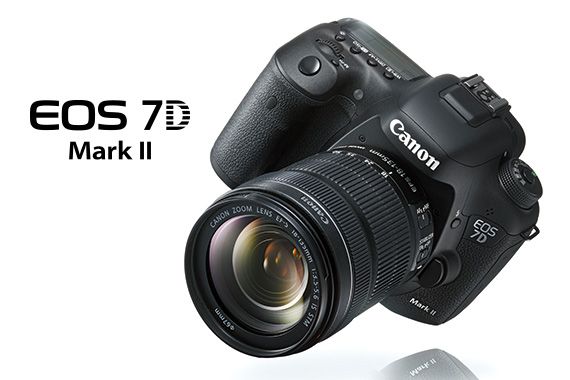
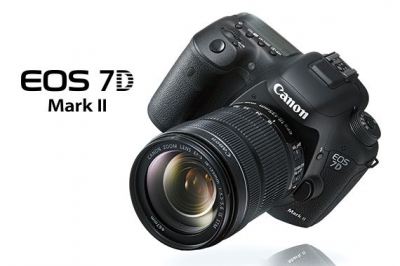
In September, 2014, Canon's EOS 7D Mark II debuts. After five long years of silence, what changes have been made to the series and what has it learnt? Focusing mainly on its appearance and specifications, I will unveil the EOS 7D Mark II in its entirety by examining the advancements made to its predecessor, the EOS 7D, and the similarities to the EOS-1D X. (Reported by: Ryosuke Takahashi)
Pages: 1 2
Shedding its veil of mystery, the EOS 7D Mark II has finally made its appearance. It has been five long years since the launch of the series' first model, the EOS 7D. With the release of the firmware version 2.0.0 in 2012, we saw a great leap in the EOS 7D, changing it almost beyond recognition. Yet, there has been no mechanical modification except for the addition of the lock mechanism for the Mode Dial, which is handled at Canon's service centres. In the meantime, the EOS-1D X and the EOS 5D Mark III have appeared with numerous advanced functions while the EOS 7D kept its silence.
Scheduled for launch in September, 2014, the EOS 7D Mark II inherits the tradition of the EOS 7D, while it is being positioned as the flagship APS-C model that is extremely close to the EOS-1D X, with further advancements made to its performance for capturing moving objects. The maximum continuous shooting speed of 10 frames per second is comparable to that of the EOS-1D X and equivalent to that of the EOS-1D Mark IV, which was the best in its days. Meanwhile, the newly-developed 65 cross-type AF points far outnumber those of the EOS-1D X, but the body remains as small as the EOS 7D, maintaining its tradition of emphasising mobility.
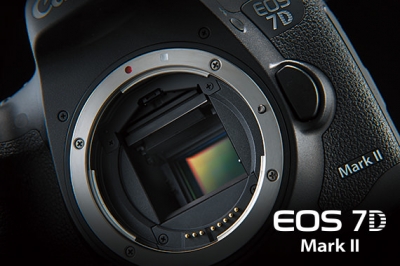
New features have been added to the operational and display parts of the EOS 7D Mark II. Its ease of use is probably the best among the EOS models. Because of its resemblance in appearance to the EOS 7D, many may think that only superficial changes have been made. However, the EOS 7D Mark II is considerably different from its predecessor, and in fact closer to the EOS-1D X in terms of functionality. Considering that it adopts the Dual Pixel CMOS AF technology, which was first introduced on the EOS 70D, and the latest Dual DIGIC 6 image processor, it should be easy to imagine how powerful this camera is.
The evolution of a camera depends on the elemental technologies, with the number of functions increasing gradually with each step up the ladder. However, the advancement made to the EOS 7D Mark II is so significant that it should be described as a leap of several steps. In this article, I will examine the power of this model by looking at the elemental technologies which underlie its advancement.
* This article is created based on a trial model. Aspects such as the appearance and image quality may differ slightly from the actual product.
EOS 7D Mark II
EOS 7D
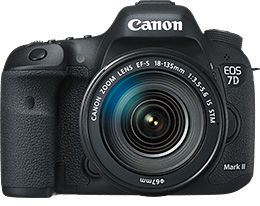
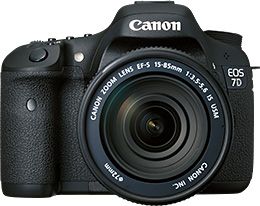
The basic contour is very similar to that of the EOS 7D, though the Depth-of-field preview button has been shifted to the grip side and made bigger for easier operation. Also, the angle of the shutter button is slightly changed, making it look more like the EOS-1D X. The curvature at the right edge of the body is also different from the EOS 7D.
EOS 7D Mark II
EOS 7D
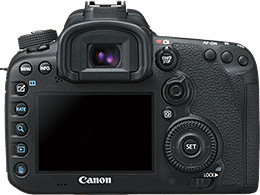
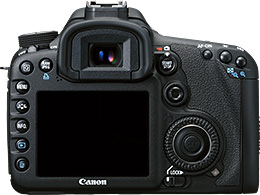
The EOS 7D Mark II is equipped with a wider LCD screen, and significant changes have also been made to the functions assigned to the buttons on the left. A lever for AF area selection has been newly added, and as with the EOS-1D X, a touch pad is incorporated to the Quick Control Dial to enhance the movie-shooting operation.
EOS 7D Mark II
EOS 7D
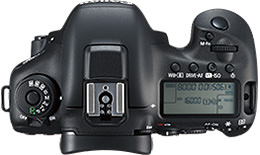
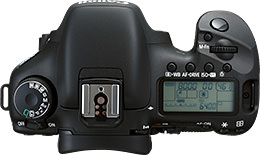
The Mode Dial comes with a lock mechanism with a GPS antenna located in front of the hot shoe. The area around the Main Dial is not as recessed compared to the EOS 7D, and protrusion is added to the ISO speed setting button in the same way as the EOS-1D X to enable blind operation.
Many major features and functionalities of the EOS 7D Mark II have shown considerable improvement compared to the EOS 7D, with some features even outperforming the specs of the EOS-1D X. There are also functions that are not found on the EOS 7D or the EOS-1D X, reflecting the influence of the EOS 5D Mark III's philosophy. Detailed settings for the continuous shooting speed are also very much enhanced. It also offers more AF area selection modes than other models, providing more powerful AF-related functions.
*● indicates features of the EOS 7D Mark II with more superior performance.
● Approx. 20.2 megapixels
Approx. 18 megapixels
Approx. 18.1 megapixels
● 65 (All cross-type)
19 (All cross-type)
61 (41 cross-type)
● EV -3 to 18
EV -0.5 to 18
EV -2 to 18
● Single-point Spot AF (Manual selection)
Single-point AF (Manual selection)
AF point expansion (Manual selection, up, down, left and right)
AF point expansion (Manual selection, surrounding points)
Zone AF (Manual selection of zone)
Large zone AF (Manual zone selection)
65-point automatic selection AF
Single-point Spot AF
Single-point AF
AF point expansion
Zone AF
19-point AF auto selection
Single-point Spot AF (Manual selection)
Single-point AF (Manual selection)
AF point expansion (Manual selection, up, down, left and right)
AF point expansion (Manual selection, surrounding points)
Zone AF (Manual selection of zone)
61-point automatic selection AF
● Approx. 150,000-pixel RGB+IR metering sensor
252-zone TTL full-aperture metering
EOS iSA (Intelligent Subject Analysis) system
63-zone TTL full-aperture metering
Approx. 100,000-pixel RGB metering sensor
252-zone TTL full-aperture metering
EOS iSA (Intelligent Subject Analysis) system
ISO 100 to 16000 (in 1/3- or one-stop increments), expandable to H1 (equivalent to ISO 25600) and H2 (equivalent to ISO 51200)
ISO 100 to 6400 (in 1/3-stop increments), expandable to ISO 12800
ISO 100 to 25600 (in 1/3- or one-stop increments), expandable to H (equivalent to ISO 51200), H1 (equivalent to ISO 102400) and H2 (equivalent to ISO 204800)
● Natural, Art standard, Art vivid, Art bold and Art embossed
N/A
N/A
Additive, Average, Bright (Comparative) and Dark (Comparative)
N/A
Additive, Average, Bright (Comparative) and Dark (Comparative)
High speed continuous shooting: up to approx. 10 fps (settable between 2 and 10 fps) *Up to 9.5 fps when EOS iTR AF is enabled.
Low speed continuous shooting: approx. 3 fps (settable between 1 and 9 fps)
Silent continuous shooting: approx. 4 fps (settable between 1 and 4 fps)
Up to approx. 8 fps
Ultra high speed continuous shooting: up to approx. 14 fps
High speed continuous shooting: up to approx. 12 fps
Low speed continuous shooting: up to approx. 3 fps
● Dual Pixel CMOS AF/Contrast detection
Contrast detection/ Phase-difference detection
Contrast detection/ Phase-difference detection
Wide 3-inch (3:2) with approx. 1,040,000 dots
3-inch with approx. 920,000 dots
Wide 3.2-inch (3:2) with approx. 1,040,000 dots

Born in Aichi in 1960, Takahashi started his freelance career in 1987 after working with an advertising photo studio and a publishing house. Photographing for major magazines, he has travelled to many parts of the world from his bases in Japan and China. Takahashi is a member of the Japan Professional Photographers Society (JPS).

A monthly magazine that believes that enjoyment of photography will increase the more one learns about camera functions. It delivers news on the latest cameras and features and regularly introduces various photography techniques.
Published by Impress Corporation



Join the Conversation