Multi-flash Photography
Beginner
Almost all of Canon's external Speedlite models in the market support wireless firing, which enables

- 0
- 0
- 0
Almost all of Canon's external Speedlite models in the market support wireless firing, which enables
Almost all of Canon's external Speedlite models in the market support wireless firing, which enables control of multiple Speedlite units. In this article, I will explain the techniques for professional multi-flash photography using two or more Speedlite flash. Although this involves a slightly high degree of technicality, you are encouraged to give it a try as it can help to create effects similar to photos taken by a professional in a studio. (Reported by: Koji Ueda)
Pages: 1 2
In this example, I placed two flash units, one facing the subject and one directly behind. I then fired the flash from behind the subject to create a beautiful silhouette by brightening the outline of her hair and body. At the same time, the flash from the front is used to adjust the brightness of the subject's face. Doing so helps to maintain the brightness of the portrait shot at an appropriate level, while making effective use of the light from the back.
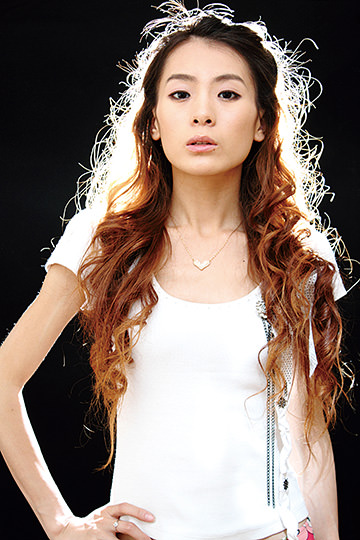
EOS 7D/ EF-S 18-55mm f/3.5-5.6 IS II/ Shutter-priority AE (1/250 sec., f/5.6, -2EV)/ ISO 640/ WB: Auto/ Flash: Wireless
Flash mode E-TTL flash/ Flash setting Master (Speedlite 580EX II): Slave 1 (Speedlite 430EX II)/ Flash ratio 1:1 = Master (Speedlite 580EX II): Slave 2 (430EX II) Flash exposure compensation Master (Speedlite 580EX II): +1EV/ Slave 1 (Speedlite 430EX II): +1EV/ Flash angle Master (Speedlite 580EX II): 24mm/ Slave 1 (Speedlite 430EX II): 24mm
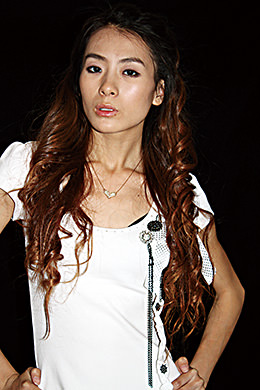
This is a portrait shot with a black background. While it is good too to make use of the simple black background, the resulting shot lacks impact. Here, I created a stronger impression by firing the flash.
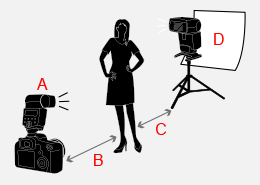
A: Master Flash ON
B: Approx. 1.5m
C: Approx. 1m
D: Slave 1
To make a product look attractive or a plate of dish appetizing, the basic technique is to photograph using oblique backlight. In the example is a shot of a cake captured using two flash units, with the main flash positioned at the far end in the image at an angle of 45º as an oblique backlight. Light from the flash casts a shadow of the subject in the foreground, adding dimensionality to the image. This strong oblique light creates an effect similar to that of the sunlight. In addition, "ceiling bounce" is employed to light from the Speedlite 580 EX II that is attached to the hot shoe of the camera to lighten the shadow and obtain a natural contrast.
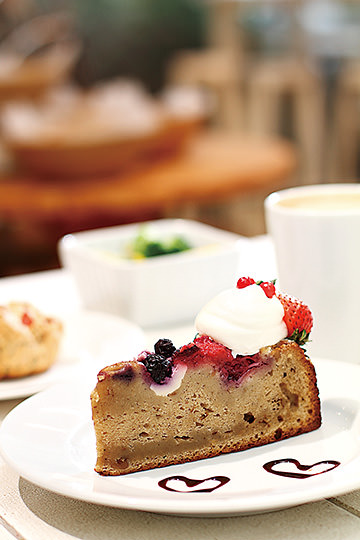
EOS 7D/ EF 50mm f/1.4 USM/ Manual exposure (1/60 sec., f/2.8)/ ISO 100/ WB: Auto/ Flash: Wireless
Flash mode Manual flash/ Flash setting Master (Speedlite 580EX II, 1/4) + Slave 1 (Speedlite 320EX, 1/128) Flash angle Master (Speedlite 580EX II): 50mm/ Slave 1 (Speedlite 320EX): 24mm
A piece of cake placed on a table. I fired the flash for this shot, as the reproduced colours lacked vividness with no clear dimensionality. Thus leaving a dull impression would have been left if flash is not used.
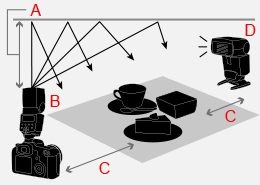
A: Approx. 2.5m
B: Master Flash ON
C: Approx. 0.6m
D: Slave 1
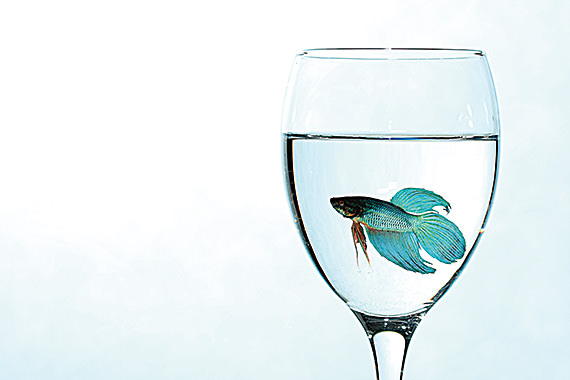
It may be more challenging than expected to reproduce fish, fruits or drinks in a glass bottle in pleasant, vivid colours. In this example, I made use of two Speedlite flash units. One of them was directed toward the wall in the backdrop and fired to brighten the background, and the diffused bounce flash was made to penetrate the glass to bring out the dimensionality and crystal-clear feel of the bright background and liquid inside the glass. In addition, I directed a second flash from the front toward the subject inside the glass. Doing so, not only brightens the colours, but also helps to prevent the subject from turning out dark due to the backlight. Adjust the flash angle to avoid reflection of the flash light from the front in the glass.
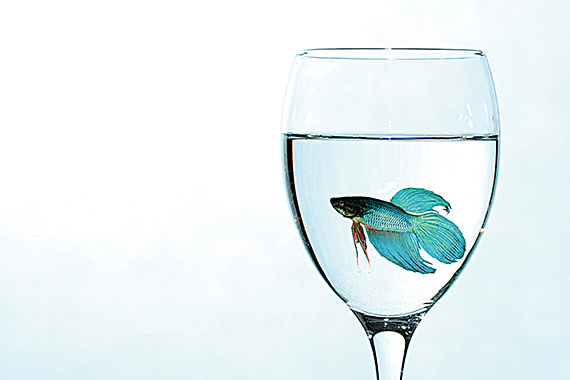
EOS 60D/ EF-S 60mm f/2.8 USM Macro/ Manual exposure (1/200 sec., f/8)/ ISO 100/ WB: Auto/ Flash: Wireless
Flash mode Manual flash/ Flash setting Master (built-in flash, OFF) + Slave 1 (Speedlite 580EX II, 1/8) + Slave 2 (Speedlite 430EX II, 1/32)/ Flash angle Slave 1 (Speedlite 580EX II): 24mm/ Slave 2 (Speedlite 430EX II): 24mm
A shot of an aquarium fish in a glass. Without a flash, the colours reproduced were dull and the impact of the photo was weak. Meanwhile, firing a flash directly may cause reflections, so I used multiple flash units in this case.
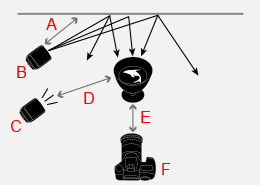
A: Approx. 0.3m
B: Slave 1
C: Slave 2
D: Approx. 0.7m
E: Approx. 0.8m
F: Master Flash OFF

Born in Hiroshima in 1982, Ueda started his career as an assistant for photographer Shinichi Hanawa. He later became a freelance photographer, and is now engaged in a wide range of work from magazines to commercials while shooting different cities and landscapes all around the world. He is also a writer and a lecturer at photography lectures and workshops.




Join the Conversation