1. Bringing out the beautiful light on the autumn leaves
Lake Tsugaru Shirakamiko is an artificial lake that was formed by the Tsugaru Dam. However, it is also surrounded by beautiful natural scenery that changes with the seasons.
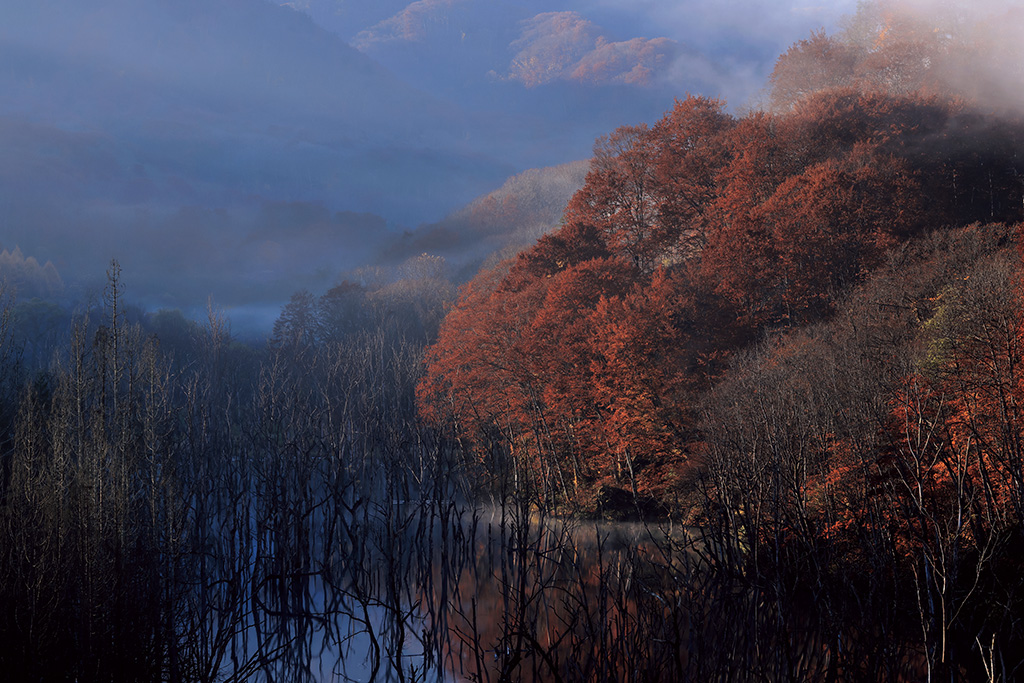
The image above was shot early on a late autumn morning. The lake’s surroundings are misty on cold mornings like this. I recommend you start shooting before sunrise—the view will keep changing as the sun goes up. If you’re like me, you’d get so engrossed with shooting that you’ll lose track of time!
Technique 1: Decide on one element to draw attention to
From the shooting spot, I identified three photogenic elements in the scene:
- The mist
- The dead trees standing in the water
- The rich red maple trees
All of them would make amazing subjects, but it would be easier to choose one to be the main subject and compose the image around it. For this image, I chose the autumn leaves, which were beautifully lit by the early morning sun. I then placed the dead trees and mist to balance the composition in a way that complemented the autumn leaves in the light.
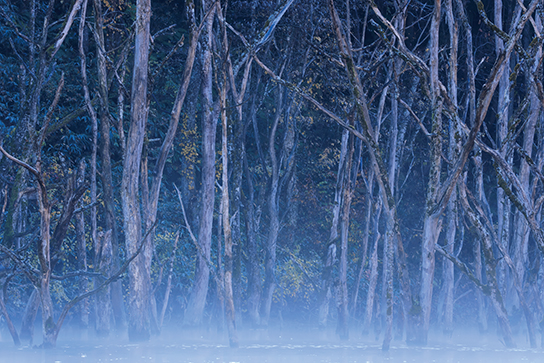
This photo has the dead trees as the main subject.
Technique 2: Use telephoto compression to add density
When faced with grand scenery that unfolds over a large area, it’s tempting to use a wide-angle lens to try to get everything in. But when you do so without a clear subject in mind, you might end up scattering the viewer’s attention instead.
For such sprawling scenes, you might find it easier to use a lens with a narrower angle of view, i.e., a standard or telephoto lens, and frame in only a specific area.
For this shot, I used a telephoto lens. The telephoto compression effect makes the different layers in the scene look close together, so the shot looks denser with less distracting empty space between elements.
TL;DR: The wider the scene, the more important it is to decide on the main interest. A wide-angle lens may not be the best choice for getting an impactful shot!
Technique 3: Reduce exposure to increase the drama
I used negative exposure compensation (EV -1.7) to underexpose the scene so that the light on the red leaves stood out. Another way to describe this is “exposing for the red leaves”.
Shooting spot: Okawashirakami Bridge Lake Tsugaru Shirakamiko
The location is around 30 minutes’ drive from the Hirosaki city centre. Travel down Prefecture Road No. 28 past the dam—you won’t miss it; it’s a huge concrete structure that’s the biggest concrete dam in Aomori Prefecture.
Be considerate: Park at a carpark, not by the road
You will see a few other shooting spots on your way there. It may be tempting, but don’t park by the roadside—you will probably end up inconveniencing others. Find a carpark instead.
2. Draw attention to a waterfall
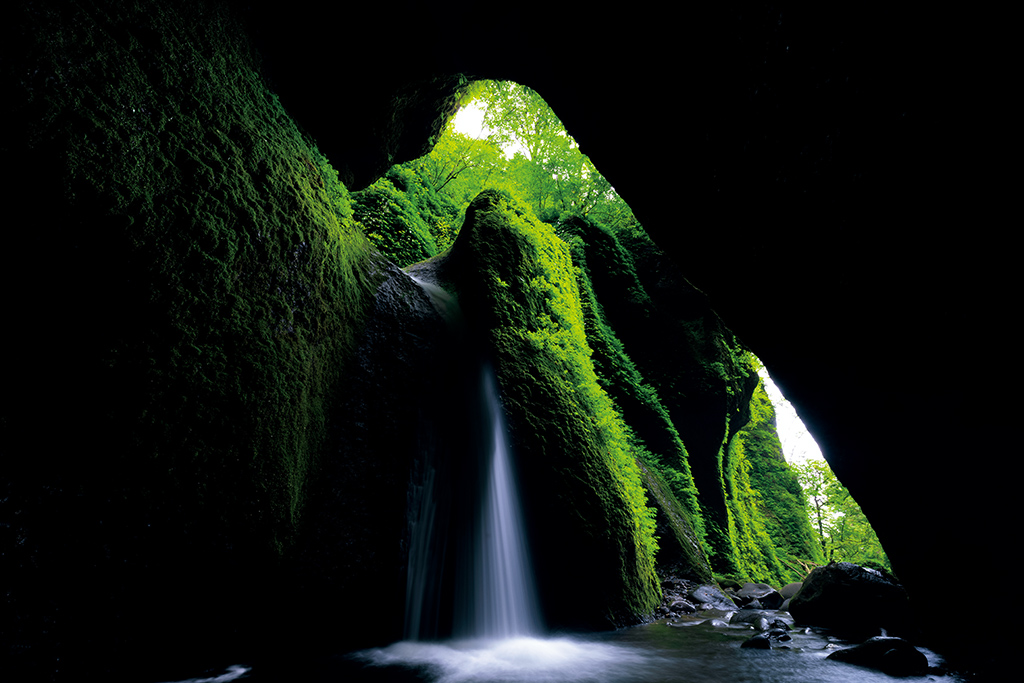
EOS R5/ RF15-35mm f/2.8L IS USM/ FL: 15mm/ Manual exposure (f/16, 3.2 sec)/ ISO 50/ WB: 5,100K
Time and date: 1:48 pm, 7 September
Location: Shiwagara Falls, Hyogo Prefecture, Japan
Image by: Takashi Karaki
A waterfall within a cave
Shiwagara Falls has a unique structure that attracts many waterfall enthusiasts in Japan. The 10m-high waterfall cascades into a cave where the only light comes from openings in the rock walls, creating a mystical atmosphere. It was this atmosphere that I wanted to bring out in my photo.
Exposing for the waterfall and moss
Don’t be afraid of crushed shadow details, even if they take up most of your picture. Here, I took advantage of the high contrast to expose for the moss and waterfall, which were the brightest elements in the scene. The areas that were darker than them became underexposed—so much that many parts are silhouettes. But these help to simplify the shot and draw attention to the moss and waterfall. The high contrast adds to the drama in the picture.
An ultra-wide-angle lens gives you more options in tight places
As the space in the cave was quite limited, I chose an ultra-wide-angle lens so that I had more framing options. The RF15-35mm f/2.8L IS USM is weather-sealed, which helps provide protection from the waterfall spray. However, I would still advise bringing a lens cloth and towel to wipe the moisture from your gear!
Shooting spot: Shiwagara Falls
Advice:
1. Be ready for a 30-minute hike on challenging terrain
Shiwagara Falls is located in a valley surrounded by several steep cliffs. Reaching it involves hiking up a relatively steep route. You will also have to cross a river. Make sure you are appropriately equipped with proper hiking footwear.
2. Best time for shooting: afternoon
That’s when the sunlight will shine into the cave.
3. Parking is available
However, parking space is limited.



Join the Conversation