[Lesson 4] Challenging Handheld Night Shots
Beginner
The theme for the fourth article of this series is ISO speed. By making effective

- 0
- 0
- 0
The theme for the fourth article of this series is ISO speed. By making effective
The theme for the fourth article of this series is ISO speed. By making effective use of the ISO speed, you can capture handheld snapshots at night. This will help to broaden the scope of your photographic expression significantly. (Reported by: Yutaka Tanekiyo)
Pages: 1 2
In addition to shutter speed and aperture, ISO speed is another crucial factor that must not be neglected. ISO speed is a numeric indication of the image sensor's sensitivity toward light, and is represented in a format such as "ISO 100" or "ISO 400". Learning to make full use of the ISO speed increases your shooting flexibility, as you will be able to utilize a wider range of apertures and shutter speeds.
For example, assuming a scene where the camera automatically sets the shutter speed and aperture to 1/30 second and f/3.5 respectively when you half-press the shutter button at ISO 100. What can you do to increase the shutter speed? If you are unable to widen the aperture any further, what you can do is to raise the ISO speed. By setting the ISO speed to ISO 400, you can increase the shutter speed to 1/125 second with the aperture remaining at f/3.5. In other words, if you are photographing a dimly-lit scene, you can raise the ISO speed to gain a faster shutter speed.
As an additional benefit, increasing the ISO speed also helps to prevent camera shake, thus reducing the risk of producing unsuccessful shots. In the following, let us try to take some actual handheld shots of night views to test the effect of raising the ISO speed.
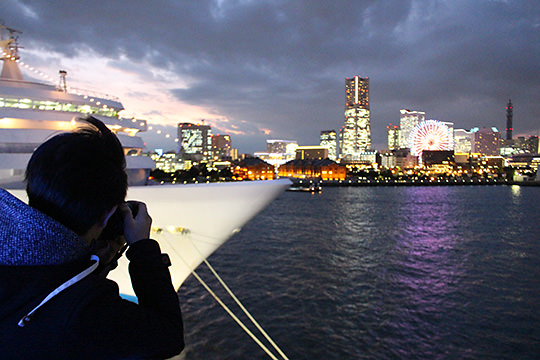
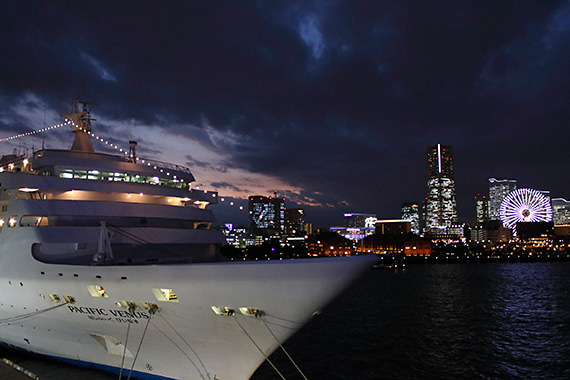
I chanced upon an attractive night view and a passenger ship which I wanted to capture, but did not carry a tripod with me. I therefore decided to take a handheld snapshot. First of all, I tried setting the ISO speed to ISO 800.
ISO 800, 1/10 sec
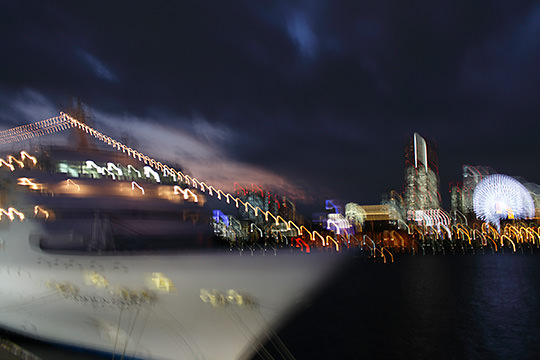
At first I thought ISO 800 was sufficient, but I was totally wrong. The shutter speed slowed down to 1/10 second, resulting in a very blurry shot.
ISO 3200, 1/40 sec
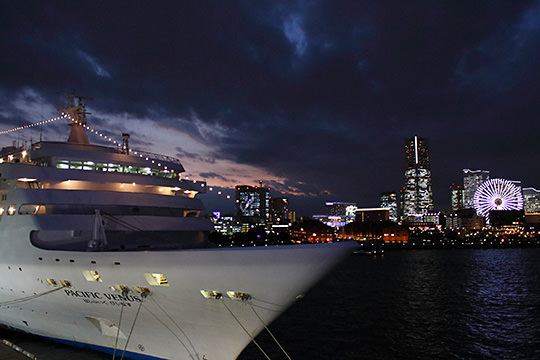
Raising the ISO speed to ISO 3200 increased the shutter speed to 1/40 second, allowing the night view to be captured clearly. Noise was also not noticeable, and the shot turned out the way I wanted. It would be a waste to have the photo of a beautiful view turn out blurry because of camera shake. If you want to capture a nightscape without using a tripod, try raising the ISO speed!
While a nightscape may look bright to the eye, it is in fact a dark subject to the camera if you are photographing from a distant location. Start by raising the ISO speed boldly to prevent camera shake; don't worry about noise. A rule of thumb commonly used to determine the right shutter speed that is free of camera shake is "1/focal length". You can therefore adjust the ISO speed using this shutter speed as a guide.
Remember to restore the ISO setting after capturing an indoor shot or a nightscape, as you might forget to do so when you move on to photograph at a bright location. In this case, the high ISO speed may cause the shutter speed and aperture to exceed the upper limit, resulting in an overexposed shot. Always remember to check the ISO speed before taking a photo.
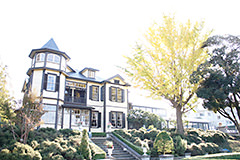
I wanted to capture a shot of this European-style architecture after coming out from the building. The ISO speed was left in the ISO 1600 setting, which I had used earlier for shooting indoors. The result was an overexposed shot with significant blowout.
Using a high ISO speed enables you to capture handheld shots in a wide variety of situations. Some of them include moving objects such as vehicles and animals, dimly-lit indoor locations such as inside a museum, and snapshots of night views. Try making good use of high ISO speeds to enjoy taking snapshots under low light conditions.
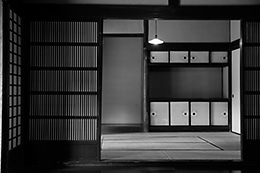
ISO 1600
A dimly-lit indoor location, where faint light from outside and a naked bulb are the only light sources. At ISO 1600, I was able to capture a clear shot without causing any camera shake.
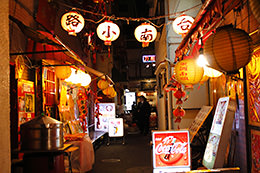
ISO 3200
This is an example of a snapshot that makes good use of a high ISO speed (ISO 3200). You are encouraged to raise the ISO speed boldly.
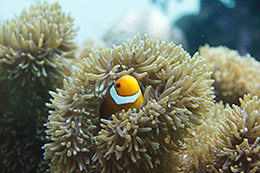
ISO 6400
Among the many different scenarios, photo shooting inside an aquarium is one of the greater challenges. You can use ISO 6400 as the standard setting if you are trying to freeze the movement of fish swimming in a dimly-lit tank.
Born in 1982 in Osaka. After graduating from the Faculty of Foreign Studies at Kyoto Sangyo University as a German language major, Tanekiyo worked as an assistant to Toshinobu Takeuchi, after which he became an independent photographer.

A monthly magazine that believes that enjoyment of photography will increase the more one learns about camera functions. It delivers news on the latest cameras and features and regularly introduces various photography techniques.
Published by Impress Corporation


Join the Conversation