How Do I Effectively Use Foreground Bokeh on a Telephoto Lens?
Beginner
Find out how using a telephoto lens to create foreground bokeh can elevate your shots and enhance your composition.




- 0
- 0
- 0
Find out how using a telephoto lens to create foreground bokeh can elevate your shots and enhance your composition.
Lovely bokeh is often associated with large aperture lenses, but it can also be easily achieved on a telephoto lens, even if your lens does not have a large maximum aperture. Two photographers share how to get the best results. (Reported by: HARUKI, Digital Camera Magazine, Neo Ng)
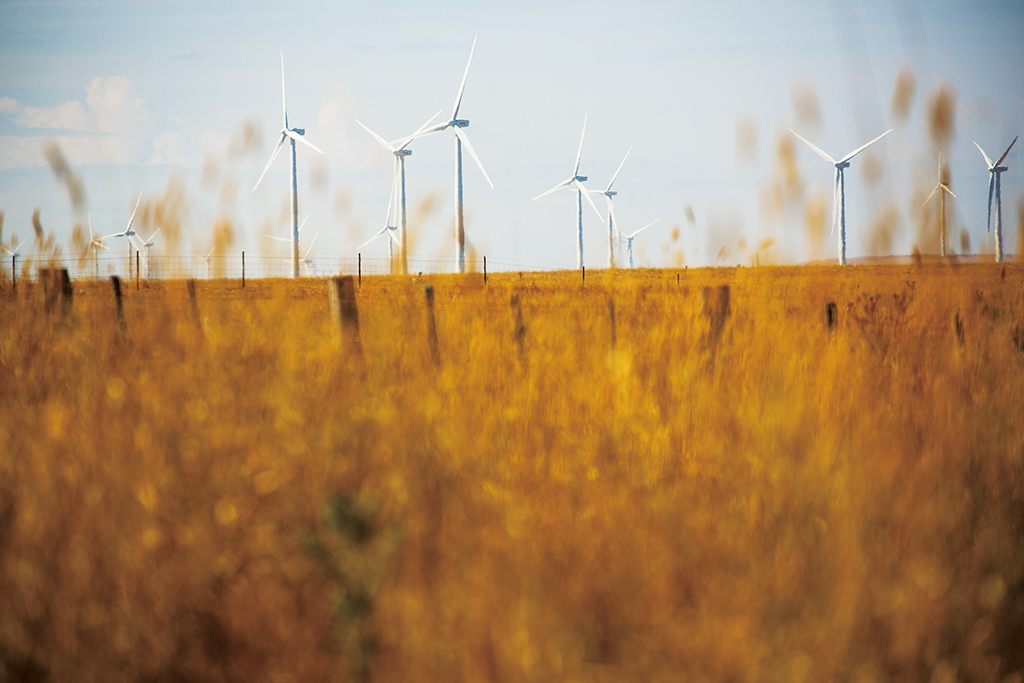
EOS 5D Mark III/ EF70-300mm f/4-5.6L IS USM/ FL:244mm/ Aperture-priority AE (f/5.6, 1/1600 sec)/ ISO 100/ WB: Auto
Photo by: HARUKI
I was in the middle of a vast wheat field, and these wind turbines were about 150m away from me—so far away, they were practically in the background. To capture the wind turbines clearly despite the distance, I shot at 244mm, and set the focus on the wind turbines in the centre.
When things are very far away, the atmosphere makes them appear less clear—a phenomenon called atmospheric perspective, also known as aerial perspective. Simply zooming into such subjects with a telephoto lens may not be enough to make them stand out, like in this case.
Most of the time, we think about putting our focus on a subject in front and making the background out of focus to create a nice bokeh in the back that makes the subject pop. However, if there is an element in front of the subject, putting it out of focus to create foreground bokeh not only simplifies distracting foreground detail, but also helps to guide the eye deeper into the scene.
Hence, for this scene, I decided to blur out the wheat fields in the foreground.
The distance of the subject necessitated a long focal length: 244mm in this case. As telephoto lenses naturally have a shallow depth of field, I got decent bokeh even at f/5.6, my maximum aperture at that focal length.
To make the most of the bokeh, I shot from a low position to incorporate more wheat into the frame, and then moved closer to the wheat so that the blurring would be more intense.
The result juxtaposes the wind turbines with the vast wheat field, with the wheat field drawing our eyes towards the wind turbines.
Learn about the factors that influence bokeh in:
Lens Basics #3: Creating Bokeh
Tip: The longer the closest focusing distance, the easier it is to create foreground bokeh
Telephoto lenses usually have a longer closest focusing distance compared to other lenses. This means that anything nearer will be out of focus by default—it’s like the lens version of long-sightedness! For example, on the EF70-300mm f/4-5.6L IS USM used for this shot, the closest focusing distance is 1.2m.
Note:
- On a telephoto zoom lens, depending on the lens design, the closest focusing distance might vary depending on the focal length.
- Super telephoto prime lenses (300m and above) tend to have a longer closest focusing distance.
Related concept: Variable aperture lenses
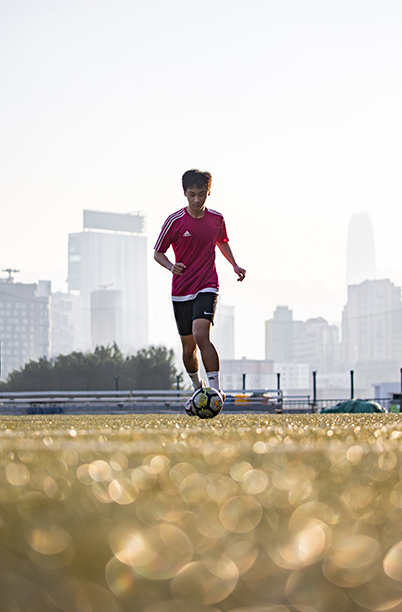
EOS R6/ EF100-400mm f/4.5-5.6L IS II USM/ FL: 106mm/ Shutter-priority AE (f/5, 1/2000 sec, EV +1)/ ISO 200
Photo by: Neo Ng (@_neo_ng_ig)
Grass itself can be a fascinating foreground element. If the light conditions are right, you can transform a normal grass field into a sea of sparkles, which, in this shot, perfectly symbolises the youthful hope and energy of the young soccer player in this sports portrait.
Shooting in backlight is challenging, but every challenge is an opportunity! When backlight reflects off the individual blades of grass, they form point light sources that are perfect for creating shiny bokeh circles.
Spot metering and AE lock are a tested and proven technique for backlit shots. Add exposure simulation into the mix, and you get a powerful combination. Here, I exposed for my subject and then locked the exposure. Use exposure compensation to fine-tune the exposure as required—the best thing is being able to see the results in the Live View display or EVF!
To incorporate more grass into the shot, I shot from a low position and low angle—so low that my camera was almost on the ground. The grass right in front of my camera automatically became out of focus as they were nearer than the closest focusing distance, transforming into shiny bokeh circles. Telephoto perspective compression makes the bokeh circles look more tightly packed together, enhancing the effect.
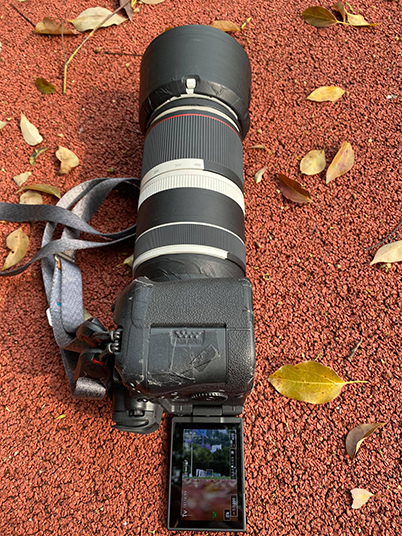
With the Vari-angle LCD monitor on my EOS R6, I didn’t have to lie on my stomach on the dirt ground to see the shot.
Tip: You get even more bokeh when the grass is wet
My image was shot when the grass was dry. But if you shoot right after it rains, or when there is morning dew, the light reflecting off the water droplets on the grass will produce even more bokeh circles.
More telephoto lens techniques in:
Professional Composition Techniques (3): Making Good Use of Lenses
Creating a Captivating Scene with Telephoto Leading Lines
5 Things to Try with a Telephoto Lens
Also see:
Lens FAQ #7: What is the difference between a 200mm and 300mm telephoto lens?
Receive the latest update on photography news, tips and tricks.
Be part of the SNAPSHOT Community.
Sign Up Now!



Join the Conversation